History of Jaipur: From Foundation to the Pink City
Jaipur is known around the world as the Pink City.
18 min read
Jaipur is known around the world as the Pink City.
Its forts, palaces, colourful bazaars, jewellery, architecture and distinctive pink facades attract millions of people. But behind the Jaipur we see today is a fascinating story of kings, astronomers, architects, merchants, craftsmen and remarkably ambitious urban planning.
Unlike many historic Indian cities that expanded gradually over centuries, Jaipur was deliberately planned and built as a new city.
Its story begins with Amer, moves through the vision of Maharaja Sawai Jai Singh II, the planning of Vidyadhar Bhattacharya, the construction of a new commercial capital in 1727, and eventually reaches the event that gave Jaipur its most famous identity: the Pink City.
So why was Jaipur built?
Why did the rulers leave Amer?
Who designed the city?
And perhaps the most popular question of all:
Why is Jaipur pink?
Let's go back to the beginning.
Before Jaipur, There Was Amer
To understand Jaipur's history, you first need to understand Amer, also commonly called Amber.
Long before Jaipur existed, Amer was the capital of the Kachwaha rulers.
Located among the Aravalli hills, Amer provided the advantages expected from an important medieval capital. Its elevated terrain and surrounding hills offered natural protection, while fortifications strengthened its defensive position.
The magnificent Amer Fort that visitors explore today is a reminder of the political and royal importance the area once held.
For centuries, the rulers governed from Amer.
But by the beginning of the 18th century, circumstances were changing.
Amer's geography made large-scale expansion difficult. The growing population also increased pressure on available resources, particularly water.
A new capital was needed.
And the ruler who would create it wasn't interested in simply building a larger version of Amer.
He had something much more ambitious in mind.
Sawai Jai Singh II: The King Behind Jaipur
Jaipur was founded by Maharaja Sawai Jai Singh II, the ruler of Amer.
Born in 1688, Jai Singh II became ruler at a young age and developed interests that extended well beyond conventional royal administration.
He had a deep interest in subjects including:
- Astronomy
- Mathematics
- Architecture
- Urban planning
- Science
His astronomical interests are particularly important to Jaipur's story.
Jai Singh established major astronomical observatories in different Indian cities, including the remarkable Jantar Mantar in Jaipur.
But his most ambitious project was not an astronomical instrument.
It was an entire city.
Why Was Jaipur Built?
By the early 1700s, Amer faced two major challenges:
A growing population and limited water availability.
Its hilly location also restricted how easily the capital could expand.
Sawai Jai Singh II therefore decided to establish a new capital on flatter land south of Amer.
But moving from the hills to the plains represented more than a geographical change.
The new city could be larger.
Its roads could be wider.
Commercial districts could be deliberately organised.
Residential areas, markets, temples and public spaces could be planned before construction rather than developing randomly over generations.
The result would become Jaipur.
Jaipur Was Founded in 1727
The foundation of Jaipur was laid in 1727.
The new city was named after its founder, Jai Singh.
But what made Jaipur particularly remarkable was not simply that a ruler established a new capital.
It was how the city was planned.
Most medieval cities in the region had developed gradually and organically.
Jaipur was different.
It was conceived as a planned city from the beginning.
The site selected south of the Amer hills provided comparatively flat terrain and enough room for the ambitious new capital.
Jaipur would become a city designed for administration, residence, craftsmanship and, importantly, trade and commerce.
Who Designed Jaipur?
One of the most important figures in Jaipur's history besides Sawai Jai Singh II was Vidyadhar Bhattacharya.
Vidyadhar was the architect and planner who worked with Jai Singh on the development of the new city.
Jaipur's design drew from traditional Indian architectural and planning principles while also incorporating other contemporary planning ideas.
The result was extraordinarily systematic for its time.
Instead of narrow streets growing unpredictably around older settlements, Jaipur was built around a grid-like street system.
Major roads crossed one another at right angles.
Different sections of the city had designated purposes.
Markets occupied important avenues.
Large public squares, known as chaupars, formed important intersections.
The city was divided into organised sectors traditionally called chowkris.
All of this was surrounded by defensive walls and gates.
Jaipur: One of India's Great Planned Cities
Imagine arriving in Jaipur during the 18th century.
Instead of entering a maze of narrow streets that had developed over hundreds of years, you would encounter broad roads, organised markets and clearly defined urban blocks.
That was unusual.
Jaipur was designed with a level of urban planning that remains visible almost 300 years later.
The historic city was divided through its grid into organised sectors, while important streets served both movement and commerce.
The original planning incorporated:
- Broad streets
- Rectangular urban blocks
- Public squares
- Commercial bazaars
- Residential areas
- Temples
- Royal buildings
- City walls
- Fortified gateways
And perhaps most importantly, Jaipur wasn't planned merely as a royal capital.
It was designed to become a commercial city.
Jaipur Was Built for Business Too
It's easy to look at historic Jaipur today and think primarily about tourism.
But commerce was fundamental to the city from the beginning.
Sawai Jai Singh II encouraged merchants, artisans and craftsmen to settle in the new capital.
Commercial activity was integrated directly into Jaipur's urban planning.
Different bazaars and neighbourhoods developed associations with particular crafts, trades and communities.
That legacy remains visible today.
Names such as:
Johari Bazaar
Tripolia Bazaar
Kishanpole Bazaar
Chandpole Bazaar
aren't modern tourist inventions.
They are part of Jaipur's long commercial history.
Even today, Jaipur remains internationally associated with jewellery, gemstones, textiles, block printing, handicrafts and traditional arts.
In that sense, the modern Jaipur market isn't separate from Jaipur's heritage.
The market itself is part of the heritage.
The Importance of Jaipur's Chaupars
One of the interesting features of historic Jaipur's planning is its chaupars.
These large public squares were created where important roads intersected.
Two names Jaipur residents still use every day are:
Badi Chaupar and Choti Chaupar.
Today they're surrounded by traffic, markets, shops and metro infrastructure.
But their existence goes back to the original planning of Jaipur.
This is one of the fascinating things about living in or visiting the old city.
You aren't simply looking at isolated historic monuments.
You're still moving through the urban framework created almost three centuries ago.
Jaipur's Historic Gates
The original city was enclosed within fortified walls and entered through large gateways.
Several historic gates remain important landmarks today.
These include names such as:
- Ajmeri Gate
- Sanganeri Gate
- Chandpole Gate
- Surajpole Gate
- Ghat Gate
- New Gate
The gates historically controlled entry into different parts of the city and connected Jaipur with routes leading towards other settlements and regions.
Today, traffic passes through and around them as part of everyday Jaipur.
That coexistence of historic infrastructure and modern urban life is one of the defining characteristics of the Pink City.
Jantar Mantar: When Jaipur Looked Towards the Sky
Sawai Jai Singh II's interest in astronomy produced one of Jaipur's most extraordinary landmarks.
Jantar Mantar.
Located near City Palace, Jantar Mantar is a collection of monumental astronomical instruments.
These structures were designed to make astronomical observations and measurements.
Their scale can be surprising.
Instead of looking like conventional scientific equipment, many resemble enormous geometric sculptures.
But they were functional instruments.
Jantar Mantar reflects an important part of Jai Singh's personality and intellectual interests.
Jaipur wasn't simply intended to demonstrate royal wealth.
Its founder was deeply interested in scientific observation and knowledge.
Today, Jantar Mantar Jaipur is a UNESCO World Heritage Site.
City Palace and the Royal Centre of Jaipur
At the heart of the new capital stood the City Palace.
The palace complex became the administrative and royal centre of Jaipur.
Rather than being isolated far away from the city, the palace was integrated into Jaipur's planned urban structure.
Over generations, Jaipur's rulers continued to expand and modify the palace complex.
Today its courtyards, gateways, museums and royal buildings offer visitors a glimpse into the lives and material culture of Jaipur's former rulers.
But Jaipur's architectural story did not end with Jai Singh II.
Successive rulers continued adding monuments that would eventually become symbols of the city.
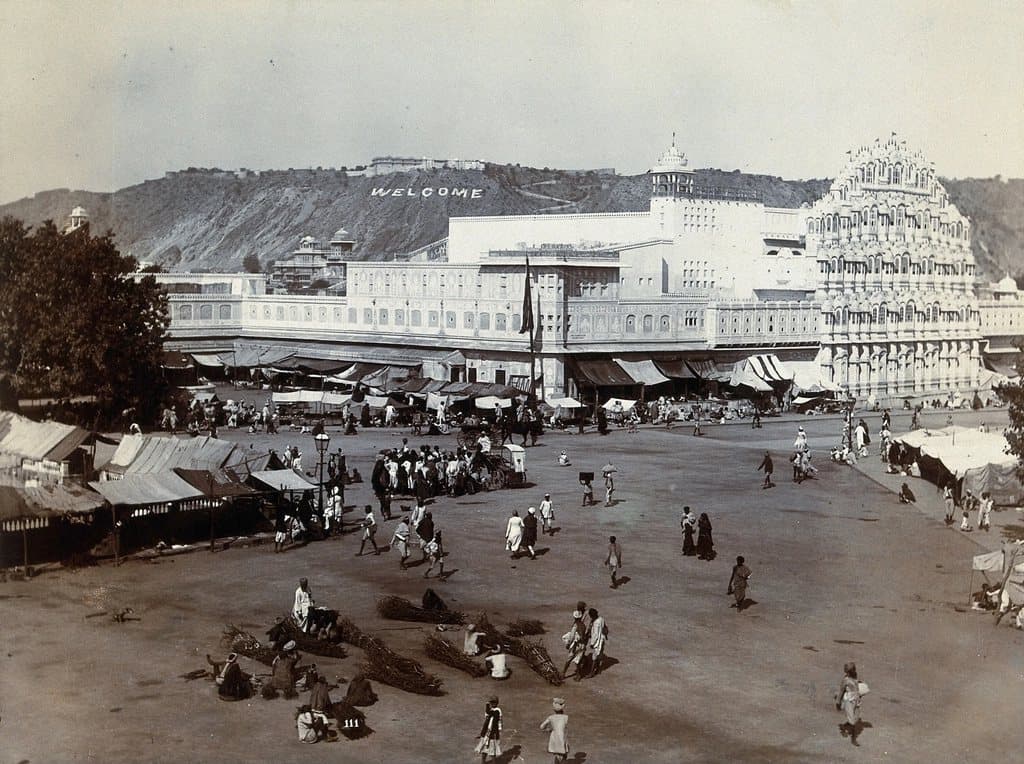
Hawa Mahal Arrives in 1799
One of Jaipur's most famous buildings was constructed decades after the city's foundation.
Hawa Mahal was built in 1799 during the reign of Sawai Pratap Singh.
Its distinctive facade, filled with small windows and jharokhas, has become perhaps the most recognisable image of Jaipur.
The structure allowed women of the royal household to observe street activity and public processions while maintaining privacy.
Today, photographs of Hawa Mahal appear on everything from Rajasthan tourism campaigns to postcards, travel videos and Instagram feeds.
Interestingly, Jaipur had already existed for more than 70 years before its most famous modern symbol appeared.
The 19th Century: Jaipur Continues to Change
Jaipur continued developing during the 19th century.
Its markets expanded.
Public buildings appeared.
Infrastructure changed.
The city gradually moved beyond the original boundaries established in the 18th century.
This period would also produce the event responsible for Jaipur's most famous nickname.
Because despite what many people assume:
Jaipur wasn't originally built as the Pink City.
The pink came later.
Much later.
Why Is Jaipur Called the Pink City?
Here's the story most people come looking for.
In 1876, Albert Edward, the Prince of Wales, who later became King Edward VII, visited Jaipur as part of his tour of India.
The ruler of Jaipur at the time, Maharaja Sawai Ram Singh II, wanted to welcome the royal visitor in grand style.
So Jaipur was painted pink.
Why pink?
The colour was associated with hospitality and welcome.
Buildings along the historic city streets were given a pink-toned appearance in preparation for the visit.
And Jaipur never really went back.
The visual identity became so strongly associated with the city that maintaining the characteristic colour eventually became part of preserving the appearance of the historic centre.
That's how a royal visit in 1876 gave Jaipur an identity recognised around the world almost 150 years later.
Is Jaipur Actually Pink?
Here's where things get interesting.
Walk around the old city and you'll notice Jaipur isn't exactly bubblegum pink.
Depending on the building, restoration, lighting and time of day, the colour can appear somewhere between:
- Terracotta
- Salmon
- Dusty rose
- Pink-orange
- Earthy red
So why call it the Pink City?
Because "The Terracotta-Salmon-Dusty-Rose City" isn't quite as catchy.
More importantly, the historical identity has always been associated with the pink colour used as a symbol of hospitality.
Over time, Pink City simply became inseparable from Jaipur.
The Prince of Wales and Albert Hall
The 1876 royal visit left another visible mark on Jaipur.
During the visit, the Prince of Wales laid the foundation stone for what would eventually become Albert Hall.
Located in Ram Niwas Garden, Albert Hall is one of Jaipur's most recognisable public buildings.
Its Indo-Saracenic architecture looks quite different from the earlier architecture of the walled city.
Today it functions as a museum and remains an important landmark, particularly when illuminated after dark.
So 1876 gave Jaipur more than its pink identity.
It also became an important moment in the city's architectural history.
Jaipur Under British Paramountcy
Like many princely states in India, Jaipur's relationship with British power became increasingly important during the 19th century.
The Jaipur state retained its princely ruler while operating within the larger political structure of British paramountcy.
During this period, Jaipur continued to modernise.
Roads, administrative systems, educational institutions, public buildings and other civic infrastructure gradually developed.
The city also continued expanding beyond its original walls.
The Jaipur envisioned in 1727 was beginning its transformation into a much larger modern city.
Sawai Man Singh II and the Last Era of Royal Jaipur
One of the most prominent figures in 20th-century Jaipur was Maharaja Sawai Man Singh II.
He became the ruler of Jaipur in 1922.
His reign coincided with a period of major change in India.
The traditional political structure of princely states was approaching its end as the Indian independence movement transformed the subcontinent.
When India became independent in 1947, Jaipur's political future changed fundamentally.
The royal capital would soon become something entirely different.
A state capital in democratic India.
Jaipur After Indian Independence
After Independence, the princely states of the region were gradually integrated into the new political structure of India.
Jaipur became part of the process that created the modern state of Rajasthan.
In the post-Independence reorganisation, Jaipur ultimately became the capital of Rajasthan.
The role of the city changed dramatically.
The former royal capital became the political and administrative centre of one of India's largest states.
Government institutions expanded.
New residential areas developed.
Road networks grew.
Universities, hospitals, businesses and industries followed.
Jaipur began expanding far beyond its historic walls.
From Walled City to Modern Jaipur
The Jaipur of Sawai Jai Singh II was compact and enclosed.
Modern Jaipur is anything but.
Over the decades, neighbourhoods developed in every direction.
Areas such as:
- C-Scheme
- Civil Lines
- Bani Park
- Malviya Nagar
- Mansarovar
- Vaishali Nagar
- Raja Park
- Jagatpura
- Vidhyadhar Nagar
- Pratap Nagar
became part of a much larger metropolitan Jaipur.
Flyovers replaced some old intersections.
The Jaipur Metro arrived.
Shopping malls appeared.
Technology companies and startups grew.
Universities expanded.
Modern cafes opened beside centuries-old markets.
And yet, at the centre of all this expansion, the original city remains remarkably recognisable.
Jaipur Becomes a UNESCO World Heritage City
A major international recognition came in 2019, when the walled city of Jaipur was inscribed on the UNESCO World Heritage List.
UNESCO highlighted Jaipur's exceptional urban planning and architecture.
The city represents an unusual combination of planning ideas, including traditional Indian concepts alongside influences from Mughal and other planning traditions.
Its grid-based layout, broad streets, chaupars, bazaars, temples, residences and uniform commercial facades collectively create an urban form of exceptional historical significance.
Perhaps even more impressive is that Jaipur remains a living city.
Johari Bazaar isn't preserved behind museum ropes.
People still buy jewellery there.
The old streets aren't empty heritage corridors.
They're packed with scooters, shops, residents, vendors, tourists and businesses.
Buildings that were designed as part of a commercial capital nearly 300 years ago remain surrounded by active commerce today.
That continuity is part of what makes Jaipur extraordinary.
Jaipur's Markets Are Living History
If you really want to understand Jaipur's history, don't spend your entire visit inside monuments.
Walk through the markets.
Visit Johari Bazaar.
Walk around Tripolia.
Explore Kishanpole.
Look at the shops around Badi Chaupar and Choti Chaupar.
The city was deliberately developed as a centre for trade and craftsmanship.
Centuries later, jewellery, gemstones, textiles, handicrafts and traditional products remain fundamental to Jaipur's economy and identity.
In other words:
Jaipur's history isn't only preserved inside palaces.
Some of it opens its shop every morning.
The Crafts That Shaped Jaipur
Jaipur's rulers encouraged skilled craftspeople and merchants to settle in the city.
Over generations, Jaipur developed strong traditions in:
- Gem cutting
- Jewellery making
- Kundan work
- Meenakari
- Block printing
- Blue pottery
- Textiles
- Marble carving
- Miniature painting
- Metalwork
- Handicrafts
Many of these traditions remain commercially important today.
This is another reason Jaipur's history feels unusually alive.
The city isn't simply displaying crafts that disappeared centuries ago.
Many are still being produced, sold, exported and reinvented.
Amer and Jaipur: Two Capitals, One Story
It's tempting to think of Amer Fort and Jaipur as separate tourist destinations.
Historically, they're chapters of the same story.
Amer represents the older hill capital of the Kachwaha rulers.
Jaipur represents the shift towards a deliberately planned city on the plains.
Visiting both helps you understand the transformation.
At Amer, you see a fortified royal centre shaped by hills and defence.
In Jaipur, you see wide streets, markets and an urban grid designed around administration and commerce.
The roughly nine-kilometre movement from Amer to Jaipur represented a much bigger change than the distance suggests.
It represented a new idea of what a capital city could be.
A Short Timeline of Jaipur's History
Before 1727
Amer serves as the capital of the Kachwaha rulers.
1727
Sawai Jai Singh II establishes Jaipur as a new capital south of Amer.
1727-1731
Much of the core infrastructure and royal/public urban framework of the planned city is developed.
18th Century
Jaipur grows as a centre of administration, trade, crafts and astronomical study.
1799
Hawa Mahal is built during the reign of Sawai Pratap Singh.
1876
Jaipur is painted pink to welcome the visiting Prince of Wales, Albert Edward.
Late 19th and Early 20th Century
Jaipur expands and gains new civic institutions, infrastructure and public architecture.
1922
Sawai Man Singh II becomes Maharaja of Jaipur.
1947
India gains independence, beginning the political integration of princely Jaipur into the Indian Union.
1956
Jaipur becomes the capital of Rajasthan in the reorganised state structure.
2019
The walled city of Jaipur is inscribed as a UNESCO World Heritage Site.
Today
Jaipur is a major Indian city and Rajasthan's capital while retaining the historic urban core created nearly three centuries ago.
Jaipur Today: Where Three Centuries Meet
Perhaps the most interesting thing about Jaipur today is the contrast.
You can take the metro to a neighbourhood planned nearly 300 years ago.
You can buy jewellery from businesses operating in commercial districts whose purpose was defined generations ago.
You can drink speciality coffee in a city historically famous for chai.
You can work from a startup office in the morning and walk through an 18th-century bazaar in the evening.
And somewhere behind the traffic, advertisements, cafes, hotels and modern buildings, Jai Singh's original city is still visible.
The roads still meet.
The chaupars still function.
The markets still trade.
The gates still stand.
The Pink City is not frozen in 1727.
It has simply kept building on top of it.
Interesting Facts About Jaipur's History
Jaipur Wasn't Always Pink
The city's famous pink identity dates primarily to 1876, roughly 150 years after Jaipur was founded.
Jaipur Was Designed Before It Was Built
Unlike cities that grew organically over centuries, Jaipur was deliberately planned around a structured urban layout.
Jaipur Was Built for Commerce
Trade wasn't an accidental result of the city's success. Commercial activity was incorporated into Jaipur's original planning.
The Old City Is Still Functioning
Many historic bazaars remain active commercial districts rather than preserved museum streets.
Jantar Mantar Reflects Jaipur's Scientific Heritage
Jaipur's founder wasn't only a ruler. Sawai Jai Singh II was deeply interested in astronomy and commissioned observatories for astronomical study.
Hawa Mahal Is Younger Than Jaipur
Jaipur was founded in 1727. Hawa Mahal appeared in 1799, more than seven decades later.
Jaipur Has Multiple UNESCO Connections
The walled city itself is a UNESCO World Heritage Site, while Jantar Mantar is separately inscribed. Amer Fort is also included as part of UNESCO's serial World Heritage property Hill Forts of Rajasthan.
Frequently Asked Questions About Jaipur's History
Who founded Jaipur?
Jaipur was founded by Maharaja Sawai Jai Singh II, ruler of Amer, in 1727.
Why was Jaipur built?
The capital was shifted from Amer as its growing population, limited water resources and restricted space created challenges. Jaipur was established on flatter land where a larger planned city could be developed.
Who planned Jaipur city?
Jaipur's planning is closely associated with Vidyadhar Bhattacharya, who worked under Sawai Jai Singh II in designing and developing the new city.
When was Jaipur founded?
Jaipur was founded in 1727.
Why is Jaipur called the Pink City?
Jaipur became known as the Pink City after Maharaja Sawai Ram Singh II had the city painted pink in 1876 to welcome Albert Edward, the Prince of Wales. Pink was associated with hospitality.
Was Jaipur always pink?
No. Jaipur had already existed for around 150 years before the famous 1876 repainting associated with the Prince of Wales's visit.
What was the capital before Jaipur?
Amer was the capital of the Kachwaha rulers before Sawai Jai Singh II established Jaipur.
Is Jaipur a UNESCO World Heritage Site?
Yes. Jaipur's historic walled city was inscribed on the UNESCO World Heritage List in 2019.
Why is Jaipur historically important?
Jaipur is important for its planned 18th-century urban design, royal history, astronomical heritage, architecture, commercial traditions, crafts and remarkably well-preserved historic urban structure.
Final Thoughts
Jaipur's story is much bigger than the reason its buildings are pink.
It is the story of a king who looked beyond the limitations of his existing capital and imagined an entirely new city.
A city built not only for royalty, but for merchants.
Not only for palaces, but for markets.
Not only for defence, but for expansion.
Not only according to tradition, but with a remarkable interest in planning, mathematics and astronomy.
Sawai Jai Singh II founded Jaipur in 1727.
Vidyadhar Bhattacharya helped translate that vision into streets, squares and neighbourhoods.
Generations of rulers, artisans, merchants and residents then gave the city its character.
A royal visit in 1876 gave it its famous colour.
Independence transformed it from a princely capital into the capital of Rajasthan.
And nearly three centuries after its foundation, Jaipur's original streets are still filled with people doing exactly what the city was designed to encourage:
living, trading, creating and meeting one another.
Maybe that's the most remarkable part of Jaipur's history.
The Pink City isn't just something Jaipur preserved.
It's something Jaipur never stopped using.