Hidden Places in Jaipur You Should Explore: 15 Lesser-Known Gems
Hawa Mahal, Amer Fort, City Palace and Jal Mahal deserve their place on every Jaipur itinerary. But Jaipur becomes much more interesting when you start exploring beyond its most photographed…
Updated 15 min read
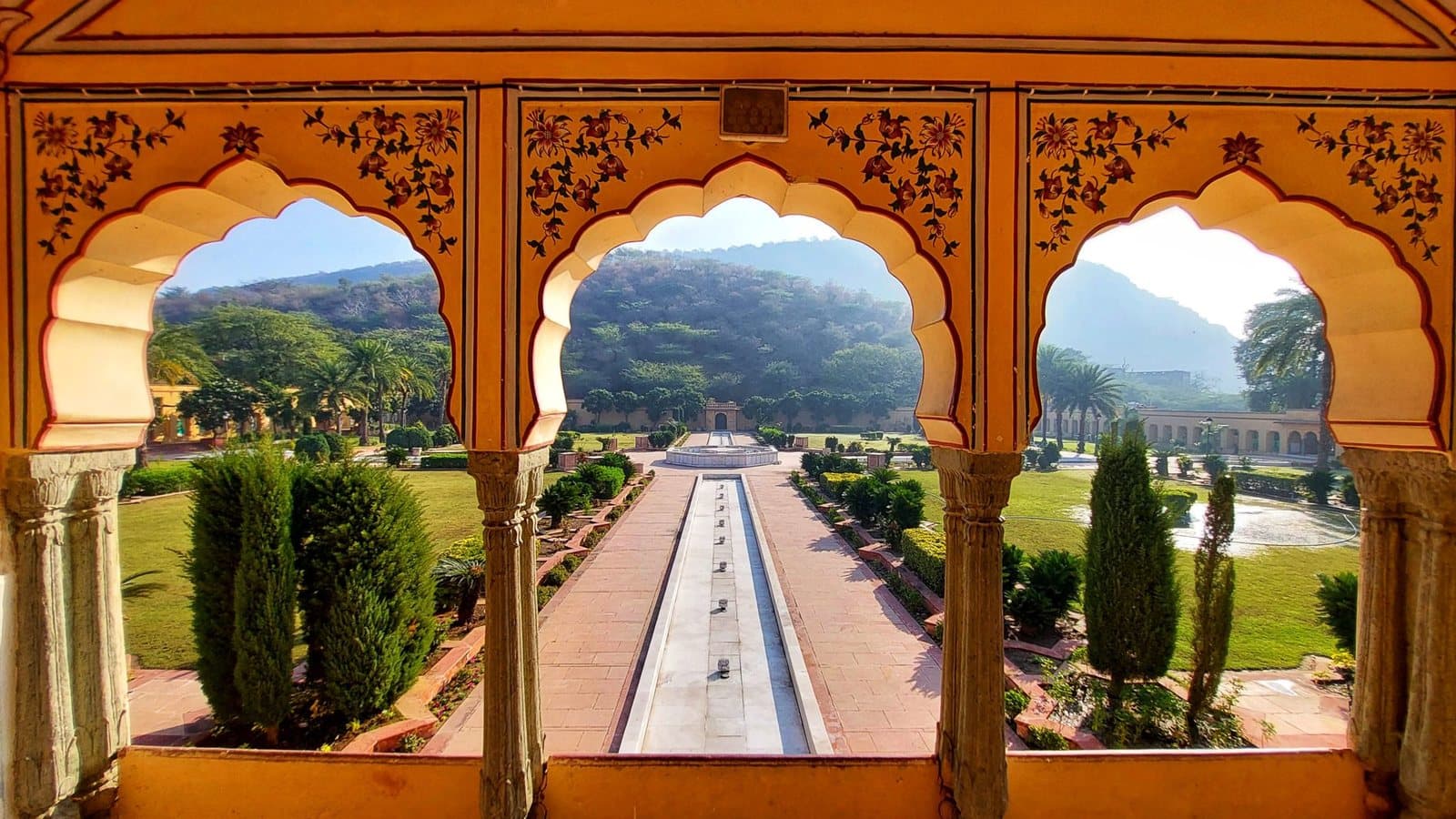
Hawa Mahal, Amer Fort, City Palace and Jal Mahal deserve their place on every Jaipur itinerary. But Jaipur becomes much more interesting when you start exploring beyond its most photographed landmarks.
Hidden between the Aravalli hills, old neighbourhoods and busy streets are historic stepwells, forgotten temples, royal structures, quiet lakes, ancient gateways and viewpoints that many visitors never reach.
Some are centuries old. Some are surprisingly close to Jaipur's famous tourist attractions. Others require you to leave the usual sightseeing route altogether.
If you've already explored the major tourist attractions or simply want to see a different side of the Pink City, here are some of the best hidden places in Jaipur you should explore.
Quick List of Hidden Places in Jaipur
If you're looking for ideas quickly, start with these:
- Gaitore Ki Chhatriyan
- Garh Ganesh Temple
- Panna Meena ka Kund
- Jagat Shiromani Temple
- Sagar Lake
- Kanak Vrindavan
- Sisodia Rani Garden
- Vidyadhar Garden
- Galta Valley and Galtaji
- Khole Ke Hanuman Ji
- Chandlai Lake
- Sambhar Lake
- Sanganer
- Royal Gaitor and Nahargarh foothills
- Jaipur's lesser-explored old-city lanes
Let's explore each one.
1. Gaitore Ki Chhatriyan
Hidden below the Nahargarh hills, Gaitore Ki Chhatriyan is one of Jaipur's most beautiful heritage sites and still receives considerably less attention than the city's major forts and palaces.
Gaitore served as the royal cremation ground of Jaipur's Kachwaha rulers.
The complex contains intricately carved cenotaphs, locally known as chhatris, built in memory of Jaipur's former rulers.
Unlike the massive scale of Amer Fort or City Palace, Gaitore is about details.
Look closely at the stone carvings, domes, pillars and geometric patterns. Different cenotaphs have their own architectural characteristics.
The surrounding hills also give the complex a peaceful setting despite being relatively close to central Jaipur.
Best for: Architecture, history and photography
Recommended time: 45 minutes to 1 hour
Apna Jaipur Tip: If you enjoy architectural photography, don't rush through Gaitore. Many of its best details are found in the ceilings, pillars and carvings rather than wide shots of the complex.
2. Garh Ganesh Temple
Most visitors see Jaipur from Nahargarh.
Far fewer make their way to Garh Ganesh Temple, located on the hills overlooking the city.
The temple is dedicated to Lord Ganesha and is particularly interesting because of its elevated location and connection with Jaipur's history.
Reaching the temple involves climbing a substantial number of steps, so this isn't a quick roadside stop.
But that's also part of what makes the experience different.
As you climb higher, you get increasingly interesting views across Jaipur.
Best for: Spirituality, views, walking and local experiences
Recommended time: 1.5 to 2 hours including the climb
Keep in mind: Wear comfortable footwear and avoid attempting the climb during the hottest part of a summer day.
3. Panna Meena ka Kund
Panna Meena ka Kund isn't completely unknown anymore, particularly among photographers, but compared with nearby Amer Fort, it remains a relatively short and often overlooked stop.
Located in the Amer area, this historic stepwell is known for its striking symmetrical staircases.
Rows of steps descend towards the water in geometric patterns, creating an architectural composition that looks almost mathematical.
The site doesn't require much time, which makes it easy to combine with Amer Fort.
Best for: Architecture, heritage and photography
Recommended time: 20 to 30 minutes
Nearby: Amer Fort and Jagat Shiromani Temple
Apna Jaipur Tip: Access to different parts of historic sites can be restricted for conservation or safety reasons. Follow the instructions displayed locally rather than trying to recreate photographs you've seen online.
4. Jagat Shiromani Temple
While thousands of visitors head towards Amer Fort, many pass close to Jagat Shiromani Temple without ever knowing it is there.
Located in Amer, this historic temple is associated with Lord Krishna and is notable for its detailed stone architecture.
The carved pillars, gateways and traditional temple design make it particularly interesting for travellers who appreciate heritage architecture.
Because it isn't usually as crowded as Jaipur's headline attractions, the experience can feel much calmer.
Best for: Architecture, temples, heritage and peaceful exploration
Recommended time: 30 to 45 minutes
A great way to explore this part of Jaipur is to combine:
Amer Fort → Panna Meena ka Kund → Jagat Shiromani Temple
Together, they provide a much broader picture of historic Amer than visiting the fort alone.
5. Sagar Lake Near Amer
Beyond the better-known monuments of Amer lies Sagar Lake, surrounded by the rugged landscape of the Aravalli hills.
It feels remarkably different from central Jaipur.
The combination of water, hills and historic surroundings makes this area particularly appealing to people looking for quieter landscapes and photography opportunities.
Depending on the season and water levels, the appearance of the area can change considerably.
Best for: Nature, photography and exploring beyond conventional tourist routes
Apna Jaipur Tip: Treat natural and heritage areas responsibly. Avoid littering, don't enter restricted areas and don't assume every trail or structure visible online is legally or safely accessible.
6. Kanak Vrindavan
Located near the road towards Amer, Kanak Vrindavan is a landscaped garden complex surrounded by the Aravalli hills.
Despite its convenient location between central Jaipur and Amer, many visitors drive straight past it while heading towards the fort.
The garden includes landscaped spaces, fountains and temple architecture, offering a quieter break from Jaipur's busier sightseeing locations.
Its setting against the surrounding hills is one of its biggest attractions.
Best for: Families, couples, photography and relaxed walks
Recommended time: 45 minutes to 1 hour
You can conveniently combine Kanak Vrindavan with Jal Mahal and Amer Fort.
7. Sisodia Rani Garden
Located away from the busiest tourist areas, Sisodia Rani Garden offers another side of Jaipur's royal heritage.
The garden was built in the 18th century and combines landscaped terraces, fountains, pavilions and painted architectural elements.
Its design reflects the tradition of royal gardens rather than the defensive architecture associated with Jaipur's forts.
For travellers who have already seen Amer, Jaigarh and Nahargarh, this offers a refreshing change of pace.
Best for: Gardens, architecture, couples and photography
Recommended time: Around 1 hour
8. Vidyadhar Garden
Not far from Sisodia Rani Garden is Vidyadhar Garden, another heritage garden that doesn't usually receive the same attention as Jaipur's major monuments.
Named after Vidyadhar Bhattacharya, the architect associated with Jaipur's original city planning, the garden combines landscaped areas and traditional architectural elements.
Visiting Vidyadhar Garden and Sisodia Rani Garden together makes sense because of their proximity.
Best for: Architecture, gardens and quiet exploration
Recommended time: 30 to 60 minutes
Suggested Route
Try:
Galtaji → Sisodia Rani Garden → Vidyadhar Garden
This creates a completely different Jaipur half-day itinerary away from the standard Amer-Hawa Mahal circuit.
9. Galta Valley and Galtaji
Galtaji itself is a recognised Jaipur attraction, but the broader Galta Valley experience still feels far removed from the polished palace circuit.
Set between rocky hills, Galtaji is an old pilgrimage complex containing temples, pavilions and sacred water tanks.
The dramatic landscape is a major part of the experience.
The site is also widely associated with the monkeys found around the complex, which is why travellers sometimes refer to it as the Monkey Temple.
However, this remains an active religious site rather than simply a tourist attraction.
Best for: Temples, spirituality, landscapes and photography
Recommended time: 1 to 2 hours
Visitor tip: Dress respectfully and avoid feeding or disturbing monkeys and other animals.
10. Khole Ke Hanuman Ji
Khole Ke Hanuman Ji is a well-known religious destination among Jaipur residents but isn't always included in conventional tourist itineraries.
Situated among the hills, the temple complex offers a combination of spirituality and natural surroundings.
For travellers interested in understanding Jaipur beyond royal monuments, visiting active religious places can provide a very different perspective on the city.
This is particularly relevant if you're interested in places that locals actually visit rather than attractions created primarily around tourism.
Best for: Spiritual visits, families and local Jaipur experiences
Recommended time: Around 1 hour
11. Chandlai Lake
If birds, open landscapes and quieter natural surroundings appeal to you more than forts, consider Chandlai Lake, located outside Jaipur's main urban area.
The lake and surrounding wetlands can attract a variety of birdlife, with the experience varying according to season and water conditions.
It is particularly interesting for birdwatchers and photographers looking for a different side of the Jaipur region.
This isn't a place to visit expecting cafes, souvenir shops or organised tourist infrastructure.
That's precisely the appeal.
Best for: Birdwatching, nature and photography
Best experience: Early morning
Important: Wildlife habitats are sensitive environments. Keep your distance from birds, avoid loud music, don't leave waste behind and don't enter areas where access is restricted.
12. Sambhar Lake
If you're willing to travel beyond Jaipur city, Sambhar Lake makes for an interesting day trip.
Located west of Jaipur, Sambhar is India's largest inland salt lake.
Its enormous open landscape feels almost surreal compared with Jaipur's dense streets and colourful architecture.
Depending on seasonal conditions, the landscape can change dramatically.
The wider area is also associated with salt production and birdlife.
Best for: Road trips, landscapes, photography and nature
Plan for: At least half a day
Important Note
Sambhar is not within Jaipur city itself, so don't include it in a tightly packed one or two-day sightseeing itinerary unless it is specifically a priority.
It works much better as a separate excursion.
13. Explore Sanganer Beyond the Airport Road
Many visitors know Sanganer primarily because Jaipur's airport is located in this part of the city.
But Sanganer has a much older identity.
The area has long associations with traditional crafts, particularly hand block printing and handmade paper.
For travellers interested in Jaipur's craft traditions, exploring workshops and businesses connected with these industries can be far more memorable than buying a generic souvenir from a tourist market.
Sanganer is also home to historic religious architecture.
Best for: Crafts, textiles, culture and local industry
Recommended time: Half a day if visiting workshops
Apna Jaipur Tip
If you specifically want to see block printing being done, research workshops beforehand rather than arriving randomly. Some production spaces are working businesses rather than tourist attractions.
14. Explore the Foothills Around Gaitore and Nahargarh
Most tourists experience Nahargarh by driving directly to the fort.
But the landscape around the Nahargarh hills and Gaitore area reveals a different relationship between historic Jaipur and the Aravallis.
Old structures, temples, neighbourhoods and views appear throughout this belt.
Rather than treating this as a specific monument to tick off your list, consider it an area for slower exploration.
This is particularly rewarding for photographers and people already familiar with Jaipur's main attractions.
Best for: Photography, walking, architecture and repeat visitors
Safety tip: Stick to established public routes and avoid isolated trails after dark.
15. Walk Through Jaipur's Lesser-Explored Old-City Lanes
Sometimes the best hidden place isn't a monument at all.
Jaipur's walled city contains much more than Hawa Mahal, Johari Bazaar and Bapu Bazaar.
The old city was historically organised around markets, neighbourhoods, crafts and communities.
Walk away from the most obvious tourist streets and you'll encounter:
- Old havelis
- Small temples
- Traditional shops
- Craftspeople
- Historic facades
- Food stalls
- Old gateways
- Residential lanes
- Specialist markets
This is where Jaipur starts feeling less like a collection of attractions and more like a living city.
A Word of Caution
These are real residential and commercial neighbourhoods.
Photograph respectfully, don't enter private buildings without permission and remember that someone's home or workplace isn't automatically a tourist attraction because it looks historic.
Best for: Street photography, architecture, food and local culture
Hidden Places in Jaipur for Couples
If you're looking for quieter places to explore together, consider:
Gaitore Ki Chhatriyan for architecture and photography.
Kanak Vrindavan for a relaxed garden setting.
Sisodia Rani Garden for heritage architecture and landscaped surroundings.
Sagar Lake area for scenery.
Chandlai Lake for an early-morning nature trip.
For sunset, Jaipur's famous hilltop viewpoints are beautiful, but don't expect them to be particularly hidden or secluded on weekends.
Hidden Places in Jaipur for Photography
Jaipur is extremely photogenic beyond Hawa Mahal and Patrika Gate.
Some particularly interesting locations include:
Gaitore Ki Chhatriyan: Intricate stone architecture.
Panna Meena ka Kund: Geometric stepwell design.
Jagat Shiromani Temple: Historic temple architecture.
Sagar Lake: Aravalli landscapes.
Galta Valley: Temples surrounded by rocky hills.
Chandlai Lake: Birds and natural landscapes.
Sanganer: Crafts, workshops and local culture.
Old Jaipur: Street photography and historic architecture.
Remember that the best photographs aren't always taken at designated Instagram spots.
Sometimes they're found simply by slowing down.
Hidden Places Near Amer Fort
Amer deserves more than simply visiting the fort and immediately returning to Jaipur.
If you're already in the area, explore:
Panna Meena ka Kund
A historic stepwell just a short distance from the fort.
Jagat Shiromani Temple
An impressive historic temple with detailed stone architecture.
Sagar Lake
A quieter natural setting beyond the main tourist circuit.
Kanak Vrindavan
A landscaped heritage garden on the route between Jaipur and Amer.
Together, these places can turn an Amer Fort visit into a much more complete half-day exploration of historic Amer.
Hidden Places in Jaipur for Nature Lovers
Jaipur is surrounded by the Aravalli landscape, so there are several options beyond monuments.
Consider:
- Chandlai Lake
- Sagar Lake
- Galta Valley
- Nahargarh hill areas
- Sambhar Lake as a day trip
The appearance of lakes and natural areas can change dramatically with rainfall and season, so manage expectations if you're visiting during particularly dry months.
Best Time to Explore Jaipur's Hidden Places
October to March
Generally the most comfortable period for walking, exploring heritage sites and spending time outdoors.
July to September
The monsoon can transform the landscape around Jaipur. Hills become greener and some water bodies look considerably better after rainfall.
However, rain can also make certain trails or outdoor areas slippery or inaccessible.
April to June
Summer temperatures in Jaipur can be intense.
If visiting outdoor locations during this period, plan them for early morning or later in the day and avoid unnecessary exposure during peak afternoon heat.
How to Plan a Hidden Jaipur Day
If you've already covered Jaipur's major attractions, here's an alternative itinerary.
Option 1: Heritage & Architecture
Gaitore Ki Chhatriyan → Garh Ganesh → Kanak Vrindavan → Panna Meena ka Kund → Jagat Shiromani Temple
This works particularly well for history and architecture lovers.
Option 2: East Jaipur
Galtaji → Sisodia Rani Garden → Vidyadhar Garden → Local food stop
This is a relaxed half-day or full-day route depending on how much time you spend at each location.
Option 3: Nature & Photography
Chandlai Lake early morning → Sanganer → Local cafe → Patrika Gate
This combines nature, crafts and photography without visiting Jaipur's major forts.
Are These Places Really "Hidden"?
Not all of them.
And that's worth saying.
Places such as Panna Meena ka Kund and Galtaji are already known among travellers. They're included because they are still frequently skipped by visitors following a standard Jaipur itinerary.
A better way to think about this guide is:
places beyond Jaipur's usual top-five tourist attractions.
Some are lesser-known tourist sites.
Some are places Jaipur residents know well but tourists rarely explore.
Others offer experiences that simply don't fit into the standard fort-palace-market itinerary.
That's what makes them worth discovering.
Tips Before Exploring Offbeat Jaipur
Check current access before travelling. Heritage sites, lakes, trails and religious places can have changing access conditions.
Start early. Jaipur's mornings are better for walking, photography and nature.
Don't rely entirely on social media. A photograph may be old, edited or taken from an area that is now restricted.
Respect religious sites. Several places in this guide are active temples rather than tourist attractions.
Protect natural areas. Carry your waste back with you and avoid disturbing wildlife.
Ask before photographing people. Particularly in workshops, markets and residential neighbourhoods.
Avoid isolated areas after dark. This is especially important around hills, lakes and unfamiliar trails.
Carry water. Many offbeat places have fewer tourist facilities than Jaipur's major monuments.
Frequently Asked Questions About Hidden Places in Jaipur
What are the best hidden places in Jaipur?
Some interesting lesser-explored places include Gaitore Ki Chhatriyan, Garh Ganesh Temple, Jagat Shiromani Temple, Sagar Lake, Kanak Vrindavan, Sisodia Rani Garden, Vidyadhar Garden and Chandlai Lake.
What are some hidden places near Amer Fort?
Panna Meena ka Kund, Jagat Shiromani Temple and Sagar Lake are good additions when exploring the Amer area.
Are there hidden places in Jaipur for couples?
Gaitore Ki Chhatriyan, Kanak Vrindavan and Sisodia Rani Garden can be good options for couples looking for places beyond Jaipur's most crowded tourist attractions.
What are the best unexplored places near Jaipur?
For travellers willing to go outside the main city, Chandlai Lake and Sambhar Lake offer very different experiences from Jaipur's forts and palaces.
Which hidden places in Jaipur are good for photography?
Gaitore Ki Chhatriyan, Panna Meena ka Kund, Jagat Shiromani Temple, Sagar Lake, Galtaji and the lanes of Jaipur's old city offer excellent photography opportunities.
Are Jaipur's hidden places safe to visit?
Many established heritage, religious and public places are regularly visited, but conditions vary. Avoid trespassing, isolated trails after dark and restricted areas. For lakes, hills and lesser-developed locations, check current local conditions before visiting.
Final Thoughts
The most famous version of Jaipur is easy to find.
It's on postcards, travel brochures and millions of Instagram photographs: Hawa Mahal's windows, Amer's courtyards, Jal Mahal floating on the lake and the view from Nahargarh.
They're famous for good reason.
But they aren't the whole city.
Look a little further and you'll find royal cenotaphs beneath the hills, centuries-old temples beside busy tourist routes, stepwells hidden around Amer, traditional workshops in Sanganer, quiet gardens and wetlands outside the urban centre.
And sometimes the most memorable experience won't have a ticket counter or a famous name.
It might simply be turning into an old Jaipur lane, discovering a tiny temple, watching an artisan work or finding an architectural detail you hadn't seen in any travel guide.
See Jaipur's famous places on your first visit.
Then start looking beyond them.
That's when the city gets really interesting.